

Symposium 2026: What is the state of quantum advantage for natural science? What are hot topics, current trends and challenges for quantum chemistry on quantum computers? In which ways may quantum computing transform conventional research and industrial R&D in these fields? Last but not least, what is the impact of recent seminal advances in classical computation for the future of quantum computation?
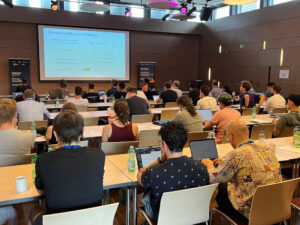
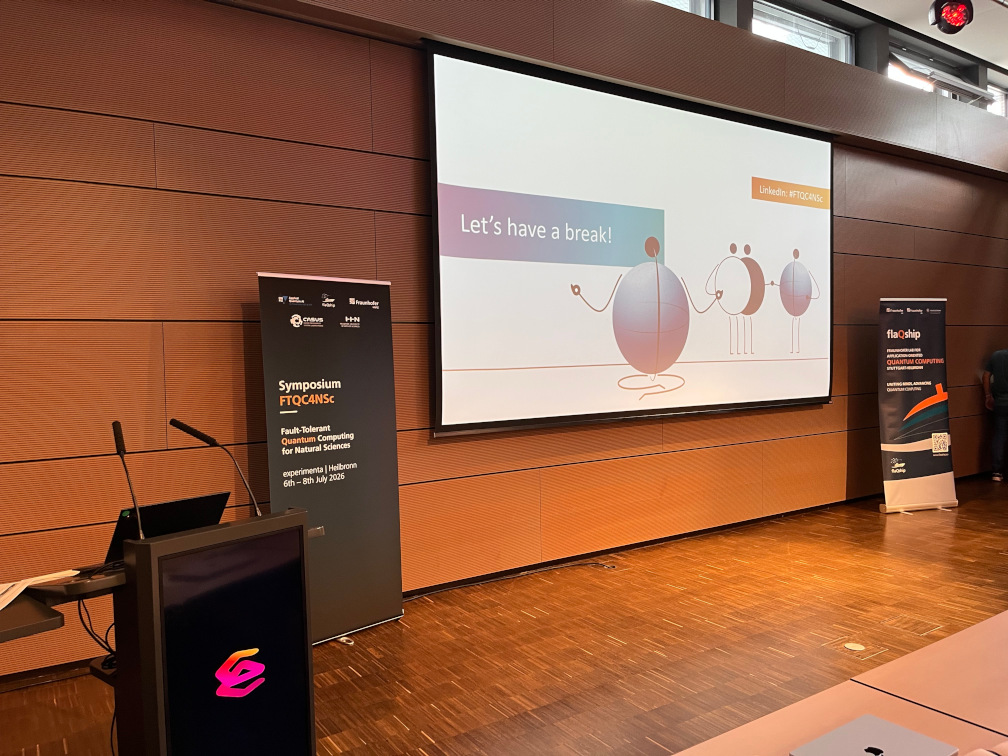
July 6. – 8. 2026 at experimenta in Heilbronn (Germany): With these questions in mind, I had the chance to attend FTQC4NSc 2026. A symposium on natural science and fault tolerance with enlightening talks by leading scientists and top speakers from the industry and the start-up ecosystem including
-
Jens Eisert (FU Berlin), Lin Lin (UC Berkeley), Barbara Terhal (TU Delft), Zoë Holmes (EPFL, Algorithmiq)
-
Google Quantum AI, IBM Quantum, Quantinuum, IQM, Xanadu, neQxt
-
Algorithmiq, HQS Simulations, Riverlane
-
Covestro, Boehringer Ingelheim
Many thanks to the teams of Fraunhofer institute and flaQship for preparing such great event and for granting one of the very limited 60 seats to me. Lately, Fraunhofer IAO has published a collection of videos for several talks:
Videos of several talks for FTQC4NSc 2026
For me this is a great opportunity to recap the event, organize my notes and do some background research. In this article you will find many details and references of selected personal highlights from FTQC4NSc 2026.
1 News about Fault Tolerance
My main focus for this article is quantum chemistry and material science. But please also note the various very interesting talks on fault tolerance. Among them, Jens Eisert (FU Berlin) himself gave a great keynote speech on how qLDPC-codes revolutionize the field and presented insights of the recent results by his team.
Bringing quantum logic into quantum error correction
A very notable contribution is the qLDPC-variant “Nearest-neighbour gates are all you need: High-rate quantum low-density parity-check codes on a planar grid”. The preprint is even one of the hottest subjects on Scirate for quantum computing in this year i.
How a complete qLDPC-pipeline could actually be engineered was sketched by Tristan Müller (IBM research) in his enlightening talk about the path to Starling.
Path to Starling – Realizing fault-tolerant quantum computation at scale
In the collection of the FTQC4NSc videos you will find more very interesting talks about fault tolerance. But as this article is on quantum chemistry and material science, let’s get to business …
2 Dissipative state preparation
There is a very active research on post – QPE (quantum phase estimation) methods. A relatively new approach is the dissipative state preparation which actually works for all initial states. Surprisingly, this even includes initial states with exponentially small or even no overlap with the target state. This feature solves a major weakness of other quantum algorithms for simulation. As this subject has recently been driven by Lin Lin from UC Berkley himself, I will briefly sketch the subject in the following section. According to Lin Lin, dissipative state preparation is a good candidate for quantum advantage in the next couple of years.
2.1 End-to-End Efficiency in Dissipative Preparation by Lin Lin (UC Berkeley)
End-to-End Efficiency in Dissipative Preparation
Every quantum machine is subject to harmful interaction with its environment. This open, dissipative character makes long quantum computations so hard. Yet, as I have already outlined in my article What is the deal with Cat-Qubits? in detail, special and carefully designed open systems might also operate to our advantage: by driving any state to a stationary target state. The maximal time, that this stabilization takes, is called the mixing time.
A few years ago researchers started to transpose this idea to the algorithm landscape. Intuitively, it might seem easy to drive any quantum system to its ground state or to a low-temperature Gibbs state: By simply placing it into a freezer. Dissipative state preparation aims to implement these dynamics by attaching the Hamiltonian of the system to an ancillary, lossy bath. As the mixing time is independent of the initial state, this approach works even with zero initial overlap with the ground state! Something that would be impossible for QPE, VQE or QITE (see below).
In 2024 Lin Lin et al. published a very promising variant, that implements the lossy coupling by using only a single additional ancilla qubit ii:
By iteratively measuring this qubit and simply resetting it to the $\lvert 0 \rangle$-state, the dissipation process is simulated. The authors designed special jump operators that couple the system to the ancilla qubit. By using a filter function $f$ with $f>0$ only for negative energy differences $E_0 – E_i$, these operators repeatedly shovel higher energy states to lower energy states and finally prepare the ground state of the system. The dynamics operate within the Heisenberg picture. Thus, the filter functions may be generically implemented without actually knowing the energy spectrum up front.
Since its publication there has been active research on the single-ancilla state preparation. Lin Lin presented a new technique for deciding the quantum phase of a system’s ground-state without actually preparing it in detail. The idea here is, to start with an representative state of a candidate phase and monitor the early-time response of phase-sensitive observables under single-ancilla cooling dynamics of the Hamiltonian. He illustrated this approach with an ice-cube that is starting to melt, indicating, that solid phase is not the stable one iii.
2.2 Implementations at Riverlane by Marius Bothe
In his talk at the FTQC4Nsc 2026 Lin Lin outlined the approach. Marius Bothe (Riverlane) later presented results from concrete implementations. Bothe emphasized, that the filter function integral often proves to be the key bottleneck of the approach and that dissipative state preparation still needs systematic efficiency improvements, as has been developed for QPE in the past.
Early fault-tolerant resource estimation for ground-state preparation
2.3 Ground State Preparation at Chemical Transition States by Soumya Sarkar (UT Sydney)
Another interesting application of the approach was presented by Soumya Sarkar (UT Sydney): The rapid dissipative ground-state preparation of chemical transition states iv.
Rapid Dissipative Ground State Preparation at Chemical Transition States
Intermediate transition states are of particular interest to estimate activation rates of chemical reactions. They often show high correlation character, as they are subject of bond creation and bond breaking. In this manner, transition states are especially hard to compute classically. Soumya Sarkar outlined an iterative method for the state-preparation of transition states. The idea is to warm start the approach with the initial state of the equilibrium reactant, which is often easy to prepare. This state is then iteratively propagated along a discretized path of reaction coordinates while being stabilized by engineered dissipative cooling. Similar to the adiabatic algorithm, this protocol relaxes the state into the low energy sector at each step. For this, the target coordinates of the transition state are estimated classically during pre-processing. The discretized path actually does not need to be physically motivated. Instead the method requires, that the Hamiltonian has to satisfy a smoothness condition along the trajectory. This guarantees, that the ground-state does not rotate too rapidly along the path.
3 Imaginary-time evolution by IQM
IQMs software lead Fedor Šimkovic gave a very enlightening overview on quantum state preparation by imaginary-time evolution and details about IQM’s implementations.
Imaginary-time evolution in the age of quantum computing
I was very impressed to learn how far this field has evolved since the original QITE-paper by Mario Motta et al. In 2020 v.
Using imaginary-time dynamics $ t \rightarrow -i \tau $, an initial state $|\psi \rangle $ naturally relaxes to the lowest energy state $ |E_0 \rangle $ of the Hamiltonian, if there is a non-trivial overlap $c_0$ between both.
\begin{align}
e^{- H \tau} \lvert \psi \rangle = \sum_n c_n e^{-E_n\tau}|E_n\rangle \longrightarrow c_0 e^{-E_0 \tau}|E_0 \rangle
\end{align}
As this evolution is non-unitary, there are several approaches using unitary quantum circuits, to implement it:
\begin{align}
\frac{e^{- H \tau} \lvert \psi \rangle}{\left\lVert \cdots \right\rVert} \longrightarrow |E_0 \rangle
\end{align}
Šimkovic outlined a great slide about the various variants and their classical and quantum algorithms, including the original papers:
-
Direct ITE
-
Variational ITE
-
Stochastic ITE
-
Spectral filter ITE
-
Double-Bracket ITE
-
Diagrammatic ITE
I didn’t find this table in any of IQM’s preprints, so it’s really worth to check out the video!
A very interesting, recent contribution by IQM are the “augmented” variants of existing methods vi. These are able to significantly improve the convergence by using the local geometry of the energy landscape. It was further outlined in the Carlos Benavides-Riveros’ talk.
Reformulating Quantum Imaginary-Time Evolution
4 Advances in Quantum Phase Estimation by Google
4.1 The talks of Nicholas Rubin and Guang Hao Low
The research on quantum phase estimation has been highly optimized during the years. It might be surprising to learn, that the field is still up to significant advances.
In his talk Nicholas Rubin (Google Quantum AI) outlined Google’s recent framework SOSSA vii, that combines two methods
-
SOS: Representing a Hamiltonian as a sum of squares
-
SA: Spectral amplification for low energy states, that reduces the query complexity of a simulation problem
Leveraging low energy assumptions for quantum speedups
SOSSA translates the simulation problem into an equivalent form, that has a more favorable spectrum ‒ namely, to its square root around the ground state energy. As the gradient of the square root function is very steep for very small values, the error bars of the modified spectrum translate into much more tighter errors on the original problem for low energy states. This results in significantly less query complexity for the algorithm (see next section for details).
Although the SOSSA-construction does not come for free, it still pays off in the overall runtime: For the examined benchmarks, the team achieves overall speedups of 4 to 195 times faster ground state energy estimation. Also, Google analyzes conditions for favorable SOSSA constructions.
By the way: In the final SOSSA-paper Google’s team also developed the novel factorization scheme DF-THC for the tensor of Coulomb integrals viii. While this scheme was not a subject of the talk, it has also become a state-of-the-art method for quantum simulations.
Google’s Guang Hao Low further outlined how SOSSA and other recent advances of the team compile to significantly smaller quantum circuits using less then 100k physical qubits.
Utility-scale electronic structure with under 100k physical qubits
4.2 Some details about the SOSSA-framework
SOSSA first shifts the Hamiltonian’s spectrum to the positive side by a lower bound of the ground state energy $ – \beta $. It then rewrites the shifted positive definite operator as a sum of squares:
\begin{align}
H + \beta 1 = \sum_{j=0}^{R-1}B_{j}^{\dagger}B_{j}
\end{align}
Using
\begin{align}
H_{\text{SOSSA}}:=\sum_{j=0}^{R-1}|j\rangle\otimes B_{j}
\end{align}
we now have the representation
\begin{align}
H + \beta 1 = H_{\text{SOSSA}}^{\dagger} H_{\text{SOSSA}}
\end{align}
Traditional QPE is usually implemented by using a LCU-block encoding of $ H / \lambda $ with appropriate big $ \lambda > \left\lVert H \right\rVert $. Quantum signal processing achieves asymptotically optimal query complexity for simulation problems that linearly scales with
\begin{align}
\text{QPE via LCU} \sim \lambda
\end{align}
SOSSA translates this to a query complexity, that scales with the norm of $ H_{\text{SOSSA}} $ and the energy uncertainty $ -\beta\leq E\leq-\beta+\Delta_\text{SOSSA} $
\begin{align}
\text{QPE via SOSSA} \sim \sqrt{\lambda_\text{SOSSA} \cdot \Delta_\text{SOSSA}}
\end{align}
Both SOSSA-parameters are computed by classical preprocessing. Obviously, a SOSSA-representation is a good representation if $ \lambda_\text{SOSSA} \cdot \Delta_\text{SOSSA} < \lambda^2 $.
5 The Quantum for Bio winner: Details by Algorithmiq
Without a doubt, one of the big news in quantum computing for chemistry in 2026 was the winner of Wellcome Leap’s “Quantum for Bio Challenge” (Q4Bio). The 2 million award was granted to Algorithmiq’s new quantum chemistry pipeline. If you had trouble to find out details about the project, then Stefan Knecht’s talk is just the right entry point for you.
5.1 Algorithmiq’s new NISQ-approach by Stefan Knecht
From Quantum Algorithms to Better Therapies and Materials
The project addressed several problems, that are common to algorithms for quantum chemistry. This research has resulted in several interesting preprints over the past couple of years. The final contribution is a new end-to-end pipeline, which is both NISQ-ready and is also able to enhances algorithms for fault tolerance. Instead of using simple toy problems, Algorithmiq demonstrated its potential on a photosensitizer drug, that is currently under clinical study for photodynamic cancer therapy.
#1 Solving the initial state problem: Like several quantum algorithms, the pipeline requires an optimized initial state, with a good overlap on the target state. For this purpose, Algorithmiq presented the new approach Adapt VMPE that is able to classically generate quantum circuits for significantly optimized initial states. Zoë Holmes outlined Adapt VMPE using Majorana Propagation in Algorihtmiq’s second talk (see below).
#2 Solving the measurement problem: In order to reach chemical precision, NISQ-frameworks like VQE need a huge amount of measurement overhead. If one tries to calculate observables classically by using quantum state tomography, like shadow tomography, the measurement overhead is comparably large. Algorithmiq introduced a generalization of classical shadow tomography, by using informationally complete measurements and locally-optimal dual frames ix x. This framework reduces the estimation errors by orders of magnitude over standard classical shadows for fixed shot budgets.
#3 Solving the post-processing problem: Current methods for NISQ-devices require very sophisticated procedures for error mitigation, which scale exponentially in general. Instead of attempting to reconstruct a noiseless quantum state or to measure chemically accurate energies directly on devices, Algorithmiq introduced Quantum Boosted DMRG: A framework, that uses noisy but still correlated data as the input for classical DMRG xi. A unique feature is, that QB-DMRG cannot under-perform standard DMRG. Instead it improves DMRG’s scaling parameter, its effective bond dimension, the more correlated the input data is.
There is actually also a nice podcast on Algorithmiq’s management perspective about the project on the New Quantum Era xii.
5.2 Majorana Propagation and Adapt VMPE by Zoë Holmes
A very important and promising contribution of the project was its progress for the initial state problem, which urgently needs to be solved for various quantum algorithms such as QPE, VQE and QITE. Zoë Holmes outlined the details of Algorithmiq’s approach in her talk
Pauli and Majorana Propagation Methods
Pauli propagation
The concept of Pauli propagation has been around quantum information for a few years now. It is a very clever strategy to approximate expectation values classically.
Just as states, quantum observables may be expanded in an appropriate basis. An appealing operator basis for this task are the Pauli strings $P_j$ of arbitrary lengths or weights:
\begin{align}
O=\sum_j \alpha_j P_j
\end{align}
Consider a quantum state evolving under a unitary operator $ U$:
\begin{align}
\langle O\rangle
=
\langle\psi|U^\dagger O U|\psi\rangle.
\end{align}
We can express the circuit $ U $ itself, using Pauli strings and fixed Clifford unitaries $C_k$:
\begin{align}
U = \prod_k C_k e^{-i \frac{\phi_k}{2} P_k}.
\end{align}
To compute the expectation value above, we can propagate each term $\alpha_j P_j$ of the observable to the left, by using the elementary commutation and anti commutation rules for the Pauli strings. Each commutation either, maps $ P_j $ to a single Pauli $ P_j’ $ or to a superposition of $ P_j $ with some other $ P_j^{”}$:
\begin{align}
P_j &\longrightarrow P_j’ \\
P_j &\longrightarrow \cos(\phi_j) P_j + \sin(\phi_j) P_j^{”}
\end{align}
Finally, we get:
\begin{align}
\langle O\rangle = \sum_\alpha c_\alpha(\phi) \langle P_\alpha \rangle
\end{align}
The coefficients $ c_\alpha $ can be computed classically and include a whole bunch of products of the terms $ \cos(\phi_j) $ and $ \sin(\phi_j) $. The expansion usually blows up exponentially. But, we may truncate it very cleverly:
-
by coefficients: if the coefficients $ c_\alpha(\phi) < \epsilon $ get small enough
-
by Pauli weight: the larger the weight or length $ k $ of the Pauli string, the more likely the term will drop out from the sum (exponentially more likely to be exact)
Majorana propagation
Unfortunately, Pauli propagation does not work well for fermionic Hamiltonians as in quantum chemistry. For this, Algorithmiq developed Majorana propagation xiii:
We can apply a very similar strategy using the Majorana basis instead of the Pauli matrices:
\begin{align}
m_{2j-1} &:= a_j+a_j^\dagger \\
m_{2j} &:= i(a_j- a_j^\dagger) \\
\end{align}
where the $ a_j, a_j^\dagger $ are the usual creation and annihilation operators. The Majorana monoms $ M_{\boldsymbol{b}} $ now take the role of the Pauli strings:
\begin{align}
M_{\boldsymbol{b}} &:= \mathrm{i}^{r_{\boldsymbol{b}}}m_{1}^{b_{1}}m_{2}^{b_{2}}\cdots m_{2N}^{b_{2N}}
\end{align}
ADAPT-VMPE: Initial state problem
But how, can this help us to solve the initial state problem? The idea of VMPE, is to classically optimize a VQE-circuit (ADAPT-VQE to be specific) using Majorana propagation, that additionally fulfills certain gate-complexity constraints xiv.
For the photosensitizer molecule of the Q4Bio project, Algorithmiq computes fermionic circuits with a guaranteed overlap of 70-85% with the true ground state. This is a great candidate for the initial state. Practical initial state preperation needs to scale polynomially with the system size. Indeed, the fermionic-gate complexity of Algorithmiq’s circuits scales only quadratically in relation to the qubits needed to implement various active spaces of the molecule (up to 100 qubits).
6 Quantum computing for the pharma industry by Michael Streif (Boehringer Ingelheim)
At the end of the day quantum computing has to solve real industrial problems, that are out of reach for today’s R&D. The pharmaceutical industry is generally considered as one of the most promising fields for this goal. In his talk Michael Streif gave an overview on the insights and developments of the quantum lab at the global player Boehringer Ingelheim in this regard.
Scientific Challenges to Apply Quantum Computing in Drug Design
If I would have to recommend a single talk of the symposium to you, I would personally probably choose this one.
6.1 The use-cases
Michael Streif outlined important challenges that quantum computing has to overcome to become useful for such a “quantum native” industry. I think, most memorable was his statement, that if his lab would had access to a scaled fault tolerant quantum computer today, they would not use it for practical purposes.
From all the potential use cases of pharma (from tissue imaging, ADME properties to clinical development), Boehringer Ingelheim had chosen molecular dynamics and binding affinity prediction of drug candidates as the target application for their R&D efforts. The thermodynamic binding affinity controls the stability of a drug-protein compound. To predict it, one needs to calculate the free energy of each part and of the compound to high precision. This leads to the first big challenge: Chemists need to identify a drug candidate with a very low binding affinity for a target protein. This requires to solve the electronic structure problem with possibly billions of different geometries and free parameters. Each involves a single QPE calculation.
6.2 The runtime challenge
As is well known, in their first step, the team decided to ignore the drug candidate and concentrate on a single very correlated protein. The P450 enzyme plays a prominent role for the metabolism of drugs and is very hard to calculate classically due to its metal core. In collaboration with different partners, the team optimized the resource requirement of the QPE computation. As wall-clock time is of central importance for practical R&D in drug design, they focused on reducing the runtime of the computation. The collaborators managed to reduce the runtime of the fault tolerant algorithm from a few days to 2 hours xv. Michael Streif compared this with classical methods for the P450 calculation:
| DFT | low accuracy | Few seconds on a local machine |
| CCSD(T) | better accuracy | Few minutes on a local machine |
| QPE | high accuracy | Few hours on FTQC |
| DMRG | High accuracy | Few days on HPC-cluster |
Yet, he also pointed out, that the chemists at Boehringer Ingelheim require results in seconds and usually do not aim for high-accuracy solution. For this, their colleagues usually resort to DFT and seldom use higher accurate CCSD(T) calculations. To be really useful for drug design, quantum computing needs to bring down the runtime from hours to seconds.
Additionally, there are two more important challenges:
6.3 The combinatorial challenge
To identify an ideal drug candidate, ways will have to be found to avoid the iteration of the huge amount of possible geometries for the drug candidates and the protein.
As Michael Streif outlined, his team analyzed different variants to bring down this number by finding new algorithms for force field analysis or predicting differences in the binding affinities of different candidates xvi. So far, this reduces the combinations but also blows up the quantum algorithm to a “QPE nested QPE” scheme. Likewise, treating all geometries coherently in a single calculation seems to be not feasible.
6.4 The applicability challenge
The team at Boehringer Ingelheim identified yet another challenge: Most quantum calculations in pharma involve proteins and drug candidates with little correlations. Quantum advantage in drug design needs new algorithms that target these regular situations.
Already a couple of years ago, Boehringer Ingelheim formulated some of these challenge in collaboration with its partners xvii.
7 Quantum computing at Covestro by Christian Gogolin
Christian Gogolin’s team at Covestro is another very prominent quantum lab in the chemical industry. Unfortunately, his talk on early fault tolerant quantum simulation is not available as a video (yet?). As I found it highly insightful, I present you at least a summary from my notes.
Throughout the symposium, there were also seminal breakthroughs in classical computation present, that Christian Gogolin and others commented on:
7.1 The power of classical computation
Currently AI is on an amazing winning streak and there is a discussion within the community how much (or how little) highly correlated chemical space this will actually leave for quantum computing to be solved.
Last but not least, there are people like Garnet Chan: The renowned quantum chemist from Caltech, who is highly regarded in the quantum computing community … but also somewhat feared.
In January 2026 Garnet Chan published a nightmare for the qc-community: A classical calculation which solved quantum computing’s posterboy example, the FeMo-cofactor xviii. He has also written a highly readable blog entry to this milestone xix .
7.2 Possible goals for quantum computation
So, how much chemical space is left for quantum computing? For one thing, Christian Gogolin and other presenters pointed out, that Garnet Chan’s computations were executed on the Frontier cluster, the biggest super computer on earth. As Stefan Knecht stated in his talk, the full FeMoCo-calculation took 32 million CPU-core hours. Additionally, Christian Gogolin emphasized, that the work involved extremely sophisticated knowledge about the problem structure. Thus, quantum computing should still be beneficial, if its algorithms provide solutions more generically.
Another possible path are quantum calculations that produce better and more accurate training datasets for AI models xx. As he pointed out, such models are already on their way to replace individual DFT calculations xxi xxii.
7.3 Early fault tolerant quantum simulation
Christian Gogolin’s team at Covestro has analyzed different options to execute quantum simulation on quantum computer as early as possible. By now VQE has proven to be not an option for the company any more. For electronic structure calculations the community has shifted its focus to early fault tolerance, which is characterized by the following constraints
-
Limited number of logical qubits
-
Slow logical gate operations
-
Low error correcting code distance
-
Reduce max depth and qubit count for total runtime
In the first contribution, that Christian Gogolin outlined, the team developed a QPE variant that takes into account all of these constraints xxiii. In the analyzed benchmark molecules the approach is still a factor 10 slower than high-precision DMRG calculations in a cluster.
Their second analysis dealt with two novel simulation algorithms, that are explicitly designed for the early fault tolerance era. Namely, the team analyzed statistical phase estimation (SPE) and Krylov subspace diagonalization (QKSD) xxiv. As these algorithms may not be widely known, the preprint gives a very nice introduction of them as well. Both methods involve very clever block encodings in combination with implementations of polynomial function of the Hamiltonian via quantum signal processing. To be comparable and to construct highly efficient quantum circuits, the team transformed both approaches to Chebyshev polynomials. As the degree of the polynomials scales linearly with the circuit size, the researchers analyzed the shot budget versus gate complexity trade-off for a fixed energy precision below 1 milli-Hartree. While QKSD admits very low gate complexity, the shot budgets blow up for larger molecules. SPE seems favorable for this task. Christian Gogolin also presented very recent and unpublished results by his team: By adapting their SPE approach to Google’s recent DF-THC advances for tensor factorization (see above), they achieved a runtime improvement by a factor 10. And this is now en par with high accuracy DMRG.
8 Quantum Dynamics at Xanadu by Danial Motlagh
Quantum dynamics is an increasingly important topic in the research on quantum computing use cases. It is a domain, for which the tradeoff between resource requirements and industrial impact seems to become more favorable compared to static problems. Yet, its industrial applications have been studied far less in the past.
Already a few years ago, Xanadu’s application team has started to focus on dynamics and has examined several of those promising applications. Xanadu’s team lead Danial Motlagh gave further insights on these developments.
Quantum Dynamics: The Next Frontier of Quantum Applications
Namely, he outlined the companies results for:
9 Industrial use cases at HQS Quantum Simulations by Jan Reiner
HQS Quantum Simulations is a quantum start-up that has very early focused on existing use cases in the chemical industry. For a while now, the company is building a software stack around spectroscopy. Spectroscopy is of central industrial importance and requires simulating the time evolution of quantum states, a natural task for quantum computers and difficult for classical methods in general. Jan Reiner presented examples of industrially relevant use cases and identified regimes that could benefit by the use of fault-tolerant quantum computing.
Spectroscopy use cases for fault-tolerant quantum computing
10 … and many others
Unfortunately the symposium was just too rich to cover all interesting topics here. Nick Blunt gave a talk about Riverlane’s novel approach for significantly more efficient logical gate synthesis for small-angle rotations and its application to Trotterization:
Significantly more efficient Clifford+T synthesis
This might seem like a niche topic. Yet, its relevance can be easily estimated on Scirate, where the preprint xxviii has so far achieved impressive 109 scite-scores.
Likewise, Nathan Fitzpatrick from Quantinuum gave a nice … but also pretty technical talk to construct a built-in feature for spin-symmetry into quantum computation
A framework for spin-adapted quantum chemistry on quantum computers
So, I urge you to check out the full collection of the videos yourself.
Have fun 🙂
11 Footnotes
i https://arxiv.org/abs/2606.19482: “Nearest-neighbour gates are all you need: High-rate quantum low-density parity-check codes on a planar grid”, by Boren Gu, Tamas Noszko, Vincent Steffan, Jens Niklas Eberhardt, Joschka Roffe, Jens Eisert, Stergios Koutsioumpas (June 2026)
ii https://link.aps.org/doi/10.1103/PhysRevResearch.6.033147: “Single-ancilla ground state preparation via Lindbladians”, by Zhiyan Ding1, Chi-Fang Chen and Lin Lin Phys. Rev. (August 2024)
iii https://arxiv.org/abs/2606.28750: “Dissipative phase decision without ground-state preparation”, by Hao-En Li, Yilun Yang, Lin Lin
iv https://arxiv.org/abs/2602.11603v2, “Rapid Dissipative Ground State Preparation at Chemical Transition States”, by Soumya Sarkar (June 2026)
v https://arxiv.org/abs/1901.07653: “Determining eigenstates and thermal states on a quantum computer using quantum imaginary time evolution”, by M. Motta et al. (Nat. Phys. 16, 205 / 2020).
vi https://arxiv.org/abs/2606.23934: “Augmenting Imaginary-Time Evolution with Local Geometric Information”, by Carlos L. Benavides-Riveros, Prachi Sharma, Fedor Šimkovic IV (June 2026)
vii https://arxiv.org/abs/2505.01528: “Quantum simulation with sum-of-squares spectral amplification”, by Robbie King, Guang Hao Low, Ryan Babbush, Rolando D. Somma, Nicholas C. Rubin (May 2025)
viii https://journals.aps.org/prx/abstract/10.1103/pb2g-j9cw: “Fast Quantum Simulation of Electronic Structure by Spectral Amplification” by Robbie King, Guang Hao Low, Ryan Babbush, Rolando D. Somma, Nicholas C. Rubin
ix https://arxiv.org/abs/2511.02555: “Improving shadow estimation with locally-optimal dual frames”, By Keijo Korhonen, Stefano Mangini, Joonas Malmi, Hetta Vappula, Daniel Cavalcanti (November 2025)
x https://arxiv.org/abs/2401.18049: “Enhanced observable estimation through classical optimization of informationally over-complete measurement data — beyond classical shadows”, By Joonas Malmi, Keijo Korhonen, Daniel Cavalcanti, Guillermo García-Pérez (January 2024)
xi https://algorithmiq.fi/publications/Q4Bio_Perspective_Paper.pdf: “Photodynamic Therapy as a Driver for Useful Quantum Advantage in Chemistry: Perspective from the Q4Bio program”, By Algorithmiq
xii https://newquantumera.transistor.fm/97: Podcast “Quantum Drug Discovery and the Path to Advantage” with Sabrina Maniscalco (CEO Algorithmiq), on The New Quantum Era
xiii https://arxiv.org/abs/2503.18939: “Simulation of Fermionic circuits using Majorana Propagation”, by Aaron Miller, Joachim Favre, Zoë Holmes, Özlem Salehi, Rahul Chakraborty, Anton Nykänen, Zoltán Zimborás, Adam Glos, Guillermo García-Pérez (March 2025)
xiv https://arxiv.org/abs/2603.23444: “Scalable quantum circuit generation for iterative ground state approximation using Majorana Propagation”, by Rahul Chakraborty, Aaron Miller, Anton Nykänen, Özlem Salehi, Fabio Tarocco, Fabijan Pavošević, Pi. A. B. Haase, Martina Stella, Adam Glos (March 2026)
xv https://journals.aps.org/prxquantum/abstract/10.1103/yngp-5fpm: “Faster Quantum Chemistry Simulations on a Quantum Computer with Improved Tensor Factorization and Active Volume Compilation” by Boehringer Ingelheim and PsiQuantum (PRX Quantum 2025)
xvi https://www.nature.com/articles/s41534-026-01275-2: “Fullqubit alchemist: quantum algorithm for alchemical free energy calculations”, by Po-Wei Huang, Gregory Boyd, Gian-Luca R. Anselmetti, Matthias Degroote, Nikolaj Moll, Raffaele Santagati, Michael Streif, Benjamin Ries, Daniel Marti-Dafcik, Hamza Jnane, Sophia Simon, Nathan Wiebe, Thomas R. Bromley & Bálint Koczor (npj quantum June 2026)
xvii https://arxiv.org/html/2301.04114v1: “Drug design on quantum computers”, by Raffaele Santagati, Alan Aspuru-Guzik, Ryan Babbush, Matthias Degroote, Leticia Gonzalez, Elica Kyoseva, Nikolaj Moll, Markus Oppel, Robert M. Parrish, Nicholas C. Rubin, Michael Streif, Christofer S. Tautermann, Horst Weiss, Nathan Wiebe, Clemens Utschig-Utschig (Nature Physics, 2024)
xviii https://arxiv.org/pdf/2601.04621: “Classical computational simulation of the FeMo-cofactor model to chemical accuracy and its implications” by Huanchen Zhai, Chenghan Li, Xing Zhang, Zhendong Li, Seunghoon Lee, Garnet Kin-Lic Chan (Jan 2026).
xix https://quantumfrontiers.com/2026/03/12/the-femo-cofactor-and-classical-and-quantum-computing/: “The FeMo-cofactor and classical and quantum computing” blog-article by Garnet Chan.
xx https://spectrum.ieee.org/quantum-chemistry: “How Quantum Data Can Teach AI to Do Better Chemistry “, By Chi Chen, Matthias Troyer
xxi https://arxiv.org/abs/2506.23971: “UMA: A Family of Universal Models for Atoms”, by Brandon M. Wood, Misko Dzamba, Xiang Fu, Meng Gao, Muhammed Shuaibi, Luis Barroso-Luque, Kareem Abdelmaqsoud, Vahe Gharakhanyan, John R. Kitchin, Daniel S. Levine, Kyle Michel, Anuroop Sriram, Taco Cohen, Abhishek Das, Ammar Rizvi, Sushree Jagriti Sahoo, Zachary W. Ulissi, C. Lawrence Zitnick
xxii https://arxiv.org/abs/2505.08762: “The Open Molecules 2025 (OMol25) Dataset, Evaluations, and Models”, by Daniel S. Levine, Muhammed Shuaibi, Evan Walter Clark Spotte-Smith, Michael G. Taylor, Muhammad R. Hasyim, Kyle Michel, Ilyes Batatia, Gábor Csányi, Misko Dzamba, Peter Eastman, Nathan C. Frey, Xiang Fu, Vahe Gharakhanyan, Aditi S. Krishnapriyan, Joshua A. Rackers, Sanjeev Raja, Ammar Rizvi, Andrew S. Rosen, Zachary Ulissi, Santiago Vargas, C. Lawrence Zitnick, Samuel M. Blau, Brandon M. Wood
xxiii https://arxiv.org/abs/2410.05369: “Error mitigation and circuit division for early fault-tolerant quantum phase estimation”, by Alicja Dutkiewicz, Stefano Polla, Maximilian Scheurer, Christian Gogolin, William J. Huggins, Thomas E. O’Brien
xxiv https://arxiv.org/abs/2603.15552: “Optimizing and Comparing Quantum Resources of Statistical Phase Estimation and Krylov Subspace Diagonalization”, by Oumarou Oumarou, Pauline J. Ollitrault, Stefano Polla, Christian Gogolin
xxv https://arxiv.org/abs/2411.13669: “Quantum Algorithm for Vibronic Dynamics: Case Study on Singlet Fission Solar Cell Design”, by Danial Motlagh, Robert A. Lang, Paarth Jain, Jorge A. Campos-Gonzalez-Angulo, William Maxwell, Tao Zeng, Alan Aspuru-Guzik, Juan Miguel Arrazola“
xxvi https://arxiv.org/abs/2601.16264: “Quantum algorithm for simulating non-adiabatic dynamics at metallic surfaces”, by Robert A. Lang, Paarth Jain, Juan Miguel Arrazola, Danial Motlagh
xxvii https://arxiv.org/abs/2405.13885: “Nonlinear Spectroscopy via Generalized Quantum Phase Estimation”, by Ignacio Loaiza, Danial Motlagh, Kasra Hejazi, Modjtaba Shokrian Zini, Alain Delgado, Juan Miguel Arrazola
xxviii https://arxiv.org/abs/2605.31544: “More efficient Clifford+T synthesis for small-angle rotations and application to Trotterization”, by Marius Bothe, Christoph Sünderhauf, Michael J. Witham, Earl T. Campbell, Nick S. Blunt